

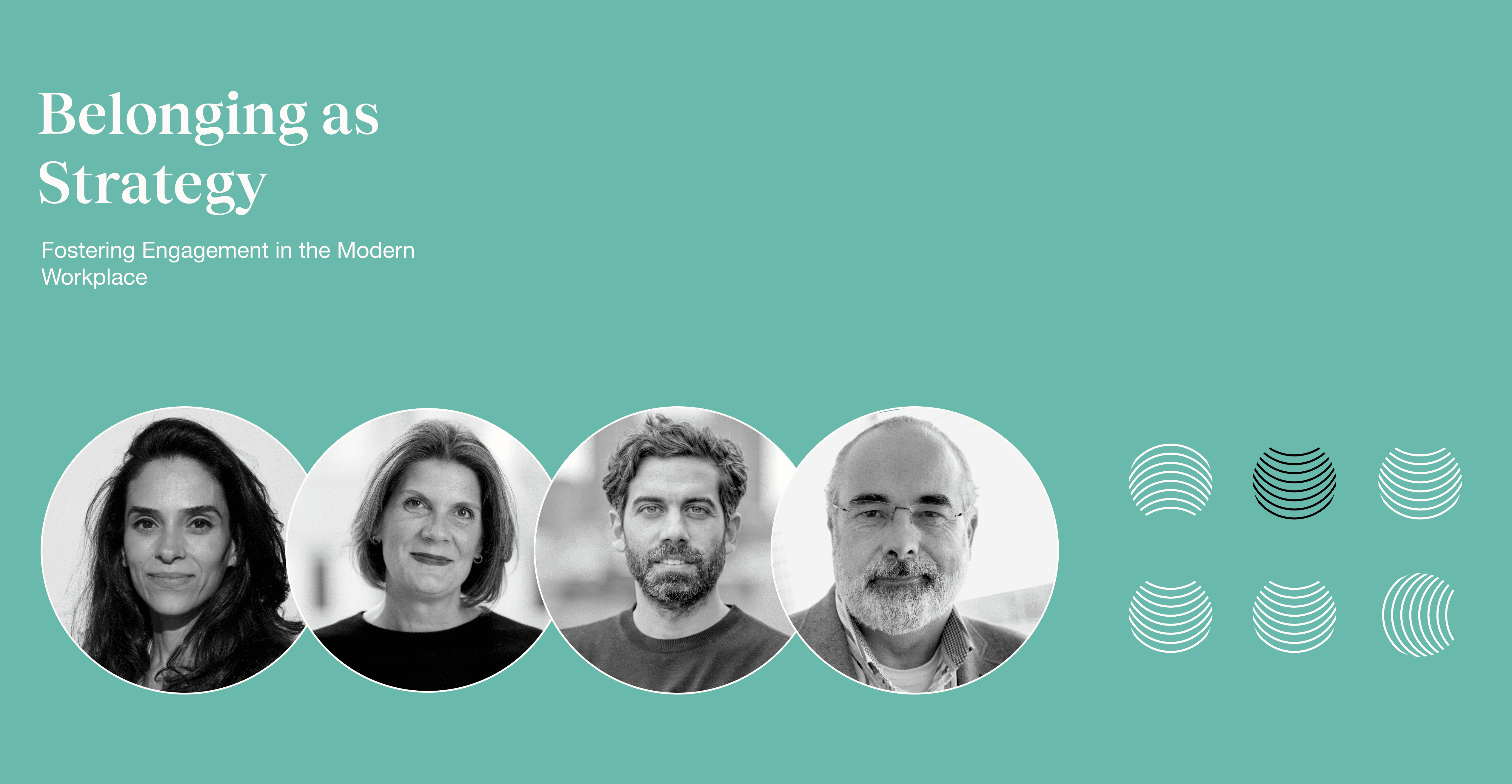
Belonging as Strategy: Fostering Engagement in the Modern Workplace
Published in ATÖLYE Insights · 5 min read · August 20, 2025
When the world feels uncertain, people reach for connection. And in the workplace, that need deepens into belonging—not just to each other, but to something meaningful.
At ATÖLYE’s Community-Powered Dialogues series, our second session, Building a Thriving Workforce: Fostering Belonging Through Employee Engagement, explored how intentional cultures of care can transform organizations from the inside out. Moderated by Nadia Muijrers, the session featured an insightful panel of leaders across strategy, communications, change, and community: Ange Dunselman-Kunzmann, Thomas Swaak, and Kerem Alper.
As Nadia reflected at the start, belonging often emerges in two ways: through moments of human connection and through shared challenges that stretch us together. That simple insight became a thread through every story that followed.
Belonging Begins in Small Moments
The panelists didn’t begin with strategy decks or KPIs, but with stories of connection that shaped them.
For Ange, it was the early days of COVID, when her global team at Philips went into lockdown. To stay close, they created rituals: video diaries of “a day in our lives,” coffee chats, playful online games. Stripped of formality, colleagues revealed their quirks and home lives.
“That broke through barriers,” she recalled. “We started to see each other fully – not just as employees, but as people.”
For Thomas, belonging appeared in one of the hardest assignments of his career: leading an education reform program across Uzbekistan. His team was scattered across villages, universities, and schools – often with no running water.
“What held us together was the sheer impossibility of the task,” he shared. “It was common purpose, but also personal connection. Against all odds, we made it work.”
And for Kerem, belonging surfaced in ATÖLYE’s annual retreats. At one, teams were asked to imagine ATÖLYE as a force of nature. One group said a mountain. Another, a river. A third, a basecamp. Different images, yet the same truth: people united by curiosity, community, and challenge.
Belonging, as these stories remind us, is not an abstract ideal. It’s lived in rituals, in adversity, in moments of being truly seen.
Beyond Desks and Offices: Belonging with Purpose
Traditionally, belonging was tethered to a desk, a building, a fixed team. But as Nadia observed,
“belonging is no longer place-bound – it flows across relationships and missions.”
Kerem echoed this shift through his work at Neol, a fully decentralized talent platform. Without an office, belonging isn’t anchored in physical space but in shared purpose.
“People come together not around desks, but around challenges,” he said.
Thomas added that today’s workers often span many overlapping teams. Belonging, then, is less about fitting neatly into one silo and more about aligning with values, missions, and the “click” of genuine connection.
This requires organizations to evolve. Instead of enforcing culture top-down, they must enable co-creation – inviting people to shape meaning together. As Thomas put it,
“Culture used to be defined at the top. Now it’s about creating the space for people to make it together.”
The Power of Croissants, Coffee, and Care
If belonging can’t be commanded, how does it scale? Through leadership that models, listens, and enables.
Ange spoke to the cultural shockwaves that ripple when a new CEO arrives: “Within a month, the culture shifts. Leaders set the tone.” Yet she also stressed that real leadership lies in listening – in seeing people as whole humans with quirks, not just roles.
Thomas illustrated this through vivid examples. At ASML, former CEO Peter Wennink would casually join staff for breakfast at 7:30am, croissant and coffee in hand. He once even showed up at Thomas’s conflict resolution masterclass, not to lead, but to listen and contribute.
“That access, that humility – it built trust,” Thomas recalled.
In another instance, two junior colleagues proposed a half-day event on inclusion. Rather than shutting it down, leadership enabled them. Six months later, 600 people – half internal, half external – gathered for a landmark conversation.
For Kerem, the key is authenticity. Leaders must do their own inner work, asking: What do I belong to here? What don’t I? Only then can they create space for others to belong on their own terms.
In today’s complex landscape, marked by hybrid work, layoffs, and uncertainty, this kind of leadership isn’t a perk. It’s mission-critical.
Bold Moves for a Fragmented World
The conversation closed with a challenge: What bold step could organizations take tomorrow to foster belonging?
The panelists offered visions that stretched beyond HR policy:
- Merge internal and external ecosystems: Stop treating employees and stakeholders as separate. Imagine HR and ecosystem teams working as one, designing both careers and partnerships as parts of a single living system.
- Build communities that cross boundaries: Like linking your sustainability team with a local innovator prototyping floating cities on water – blurring lines between “inside” and “outside.”
- Take a stand: In an age of systemic distrust, the Edelman Trust Barometer shows people still trust their employers. This is a moment for leaders to act with values and transparency.
As Ange reminded us, “People are anxious. They’re looking for something stable to trust. And today, more than ever, that’s the organization they belong to.”
A Conversation Worth Continuing
In an era of disengagement and uncertainty, belonging isn’t a luxury. It’s a strategic foundation – fueling resilience, innovation, and trust.
At ATÖLYE, we believe organizations must transform from static hierarchies to dynamic communities – places where autonomy, purpose, and connection coexist. This is the essence of our Community-Powered movement.
→ How does belonging show up in your organization? Where do people feel most alive, and where do they still feel unseen?
We’d love to hear your reflections. Join the conversation or reach out to us directly to explore how we might build thriving cultures together.